Bye bye Hookmark, apparently my current subscription ended. I cannot justify subscribing to this app just to be able to browse hookmark files created when my subscription was active. I’ll need to update some of my Craft templates to remove all my hookmark file references. Tedious.
I spent some time this morning to update my content creator toolset mini website. It was long overdue.
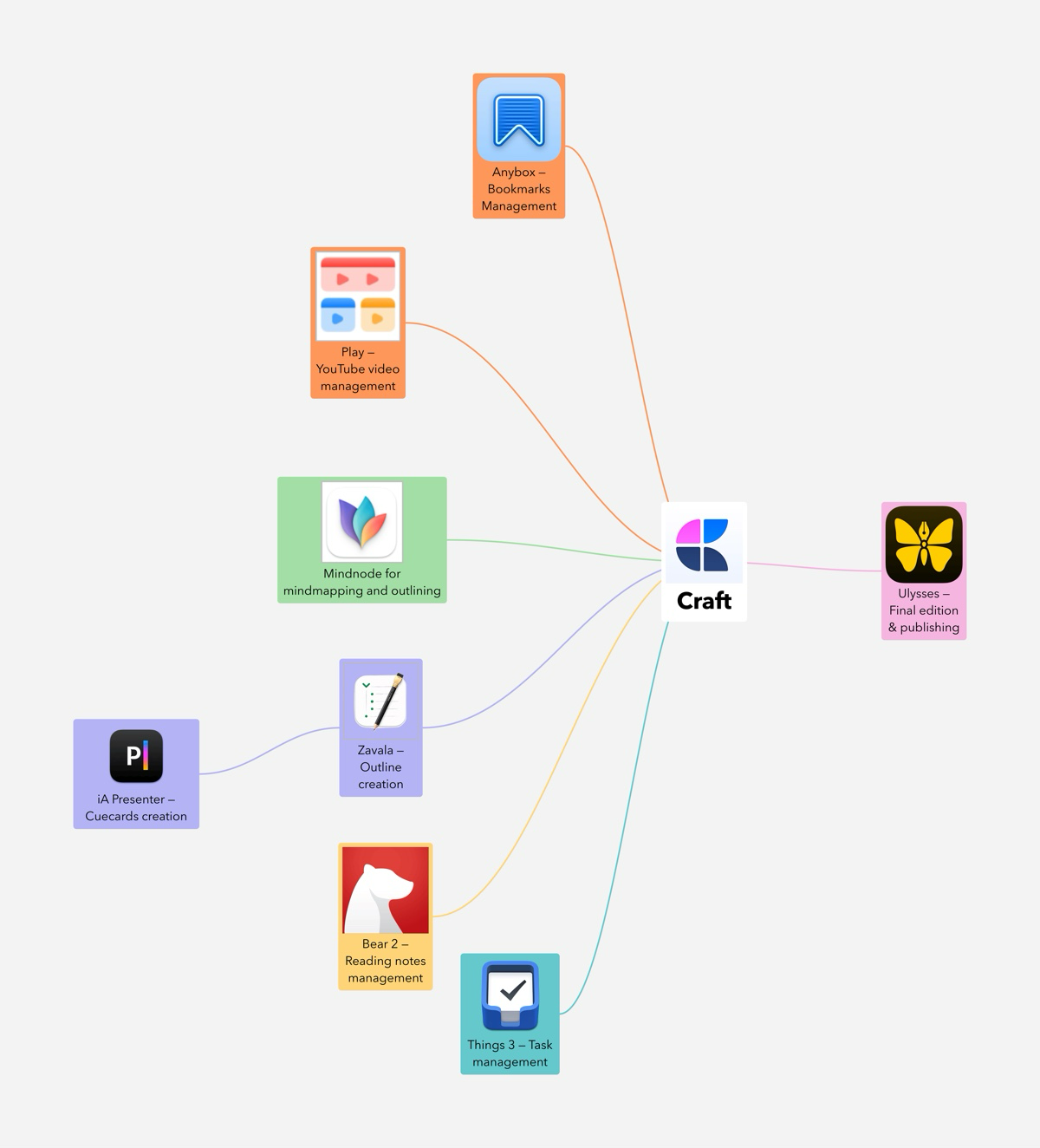
Combining Craft And Things 3 For My Writing Projects
This article is about how I’m using Craft and Things 3, which is behind any short or long article I share online. Here is what happens when I get a new post idea.
- In Things 3, Create an entry and set priority and desired or expected date of publication if known.
- In Craft, I create a new document, set the title and then copy the document’s deeplink to the clipboard.
- Still within Craft, I move the newly created document to the appropriate folder.
- Still within Craft, I update my private creator dashboard document optionally.
- Back to Things 3, and I paste the deeplink into the note field. It’s handy to jump from Things 3 to Craft with a single tap.
At this point, I can start my research, writing and editing of my article or blog post in Craft. Now, here is what happens after publishing my article:
- Mark the to-do item as done in Things 3.
- I update my private creator dashboard document by converting my deeplink to a new permalink that I put in the Recently Published section.
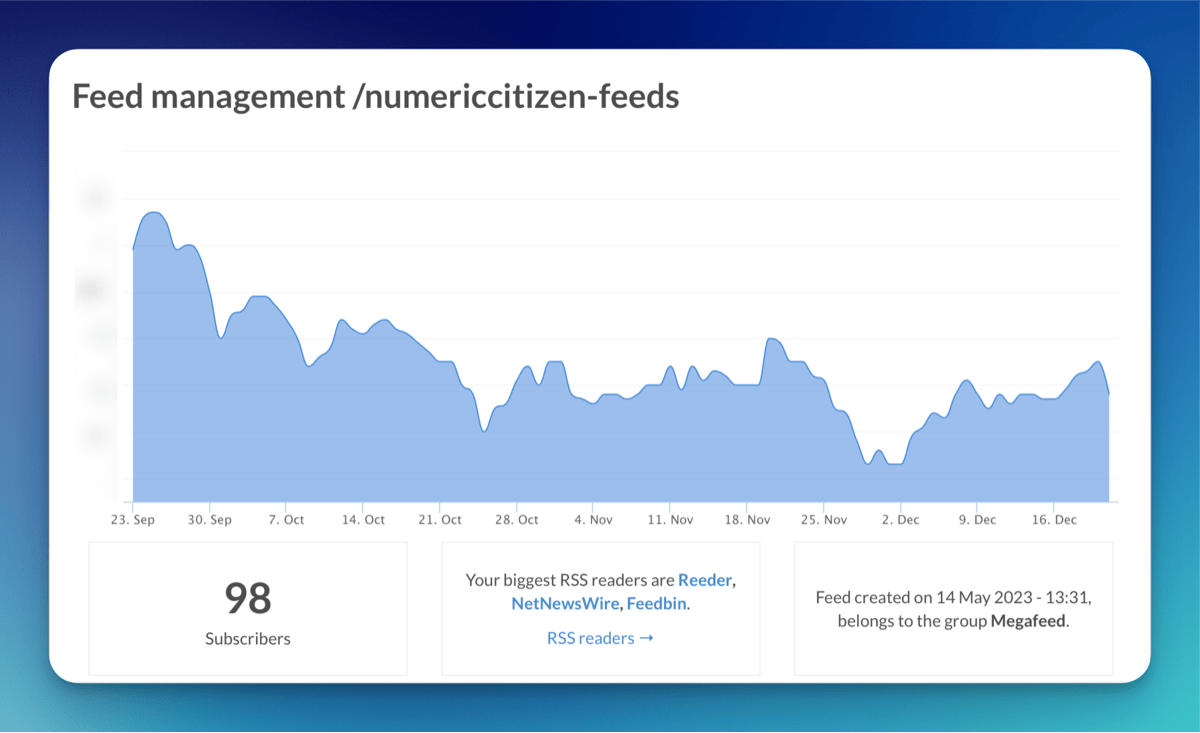
- I monitor the appropriate RSS feed for quality control. See this article about subscribing to my own RSS feeds.
There you have it. Craft plays a central role in my blogger workflow1. This blog post exposes what happens at the beginning and at the end of a new post idea. I hope you enjoyed it and maybe learned something.
-
Not all blog posts start in Craft. Far from it. ↩︎
Combining Craft And Things 3 For My Writing Projects
This article is about how I’m using Craft and Things 3, which is behind any short or long article I share online. Here is what happens when I get a new post idea.
- In Things 3, Create an entry and set priority and desired or expected date of publication if known.
- In Craft, I create a new document, set the title and then copy the document’s deeplink to the clipboard.
- Still within Craft, I move the newly created document in the appropriate folder.
- Still within Craft, I optionally update my private creator dashboard document.
- Back to Things 3 and I paste the deeplink in the note field. It’s handy to jump from Things 3 to Craft with a single tap.
At this point, I can start my research, writing and editing of my article or blog post in Craft. Now, here is what happens after publishing my article:
- Mark the to-do item as done in Things 3.
- I update my private creator dashboard document by converting my deeplink to a new a permalink that I put in the Recently Published section.
- I monitor the appropriate RSS feed for quality control. See this article about subscribing to my own RSS feeds.
There you have it. Craft plays a central role in My Blogger Workflow. This blog post exposes what happens at the beginning and at the end of a new post idea. I hope you enjoyed it and maybe learned something.
If you want a peak at my current reading notes management workflow, you might find this video interesting (Craft, Bear 2, Omnivore, Readwise).
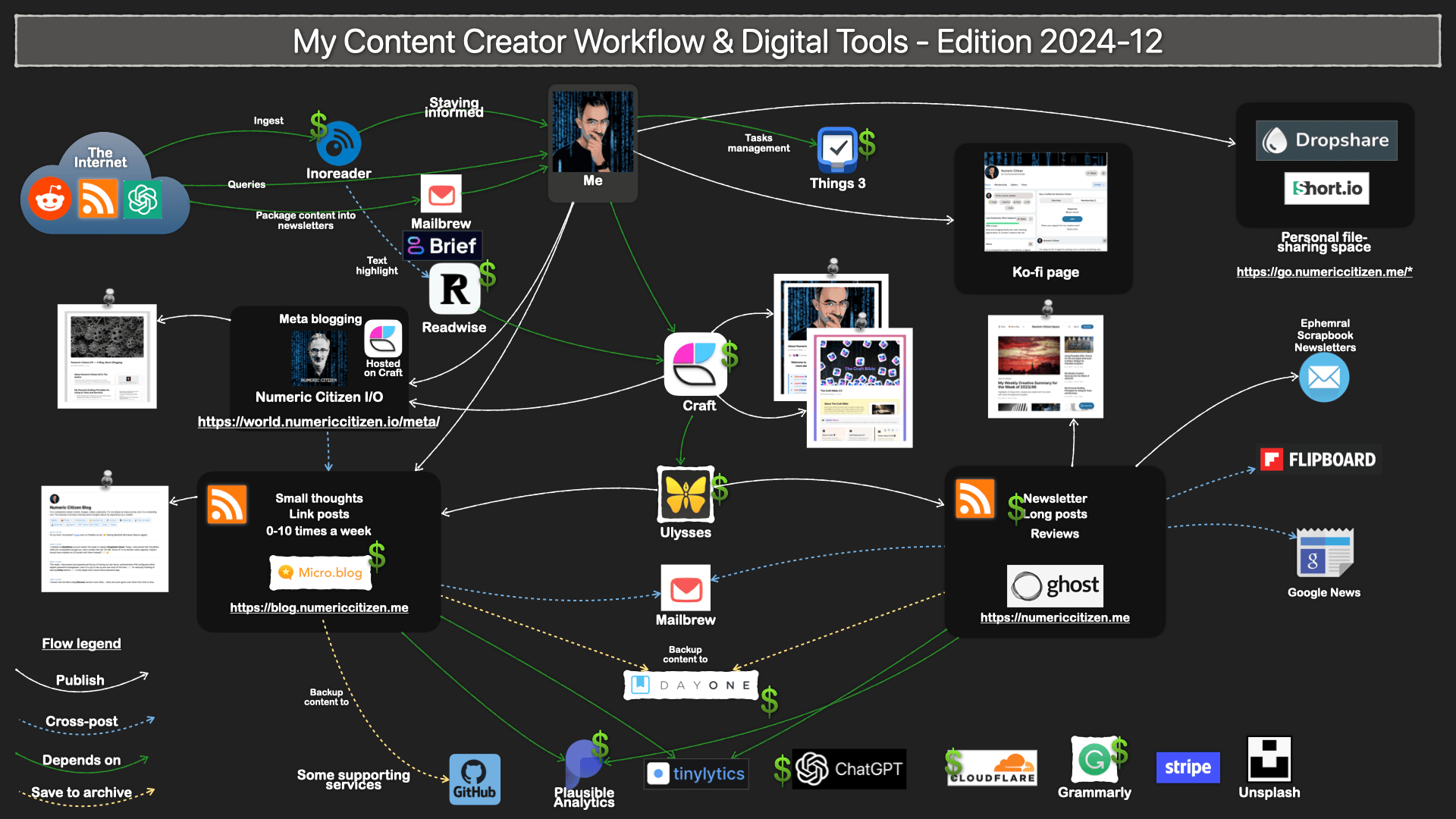
My Content Creator Workflow as of 2023-11
My creative workflow as of 2023-11. You can download an higher resolution here.
This 2023-11 version has a few changes and a cleaner and more focused workflow. Before going into specific details, I wanted to remind readers that I support the " POSSE " idea. You can read one post about it here. This workflow presented reflects this. As a reminder, here is one definition of the POSSE principle according to ChatGPT:
“POSSE” is an acronym that stands for “Publish (on your) Own Site, Syndicate Elsewhere.” It’s a content publishing model that first encourages publishing content on your own website, and then syndicating (or sharing) that content on other platforms or websites. This approach is often recommended in digital marketing and personal branding strategies, as it allows individuals to maintain control over their original content while still benefiting from the audience and engagement found on larger, established platforms. The POSSE model is particularly relevant in the context of blogging, social media, and online content creation.
Welcome AI, welcome ChatGPT, Dall-E, Midjourney
AI is making an official entry in my creative workflow. I wrote a long piece stating my guidelines for using AI in my creative work. You should read those and maybe get some inspiration out of them. The header image of this article was generated using Dall-E.
A new setup to share files easily
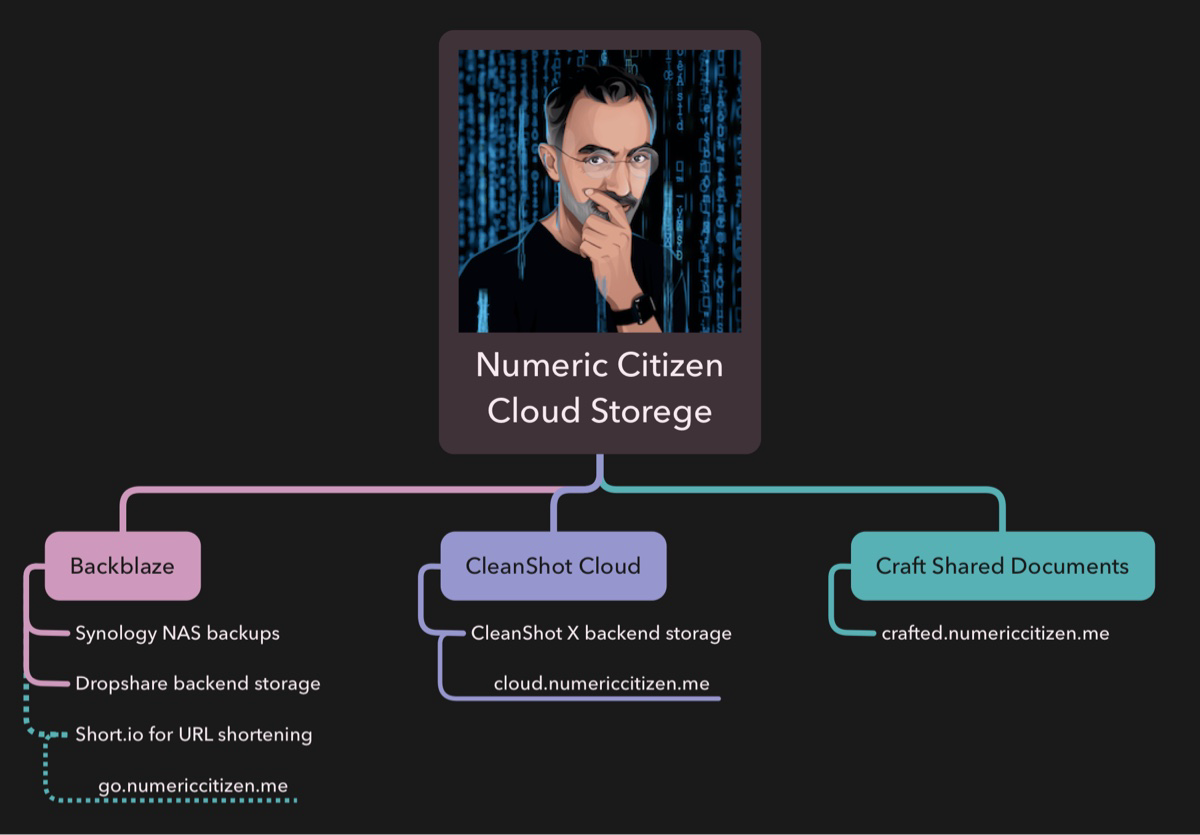
Dropshare coupled with Short.io enables me to share files like screenshots or other things. The setup was documented in detail in a previous article on this meta blog. Behind the scene, Dropshare is configured to use Backblaze to store files in a S3 bucket.
Bye bye to my Digital Garden
I came to the conclusion that a digital garden isn’t something for me. I decided to move some portions into my official about page. You can still access the remains of the garden, here.
A fun experience with Tinylytics
I’ve been using Plausible for my analytics needs but a cool guy (the same who’s also working with Manton Reece on Micro.blog hosting service, developed a lightweight version which I decided to support.
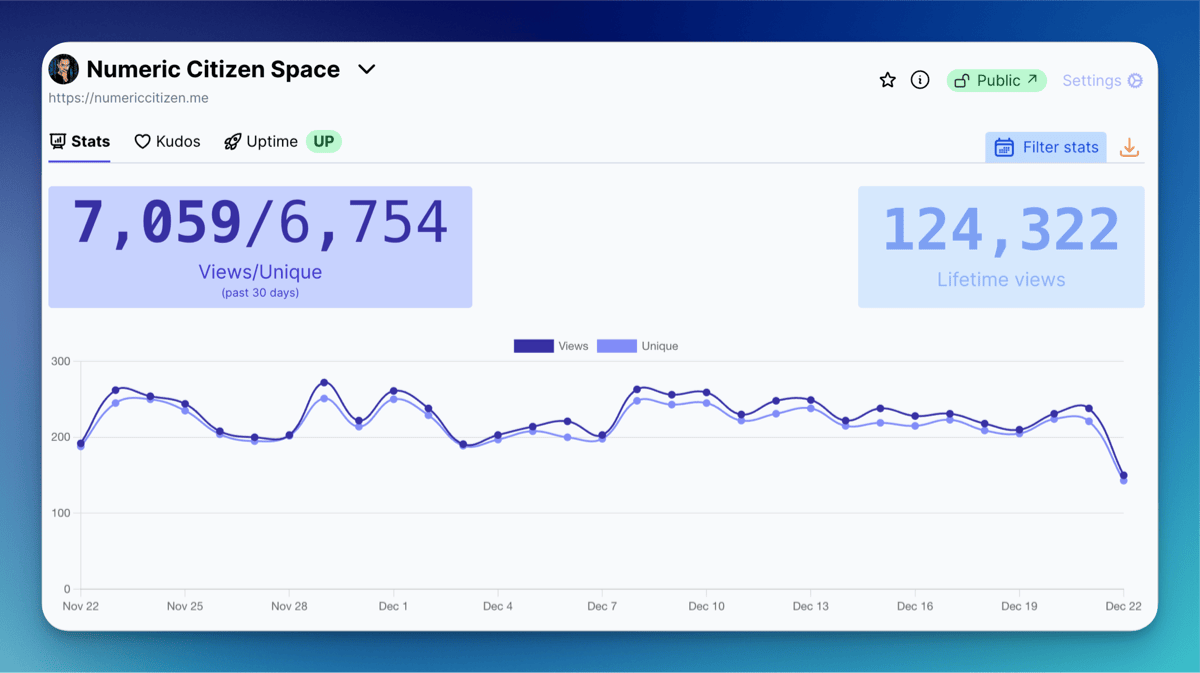
The Tinylytics dashboard
Google Sheets is out too
I was using Google Sheets to save links to every post on Micro.blog via an IFTTT automation. I no longer feel the need to key this in place.
Brief
Brief is now part of my workflow because they also took over Mailbrew, both are forming a powerful content consumption enabler duo. Some of my Mailbrew newsletters contain Brief as a source for news, which is heavily using AI for summarization.
Why It’s So Hard to Make Up My Mind About Digital Tools?
This article posted back in 2022, was a glimpse at a great moment of confusion. Following the publication of “Things That Don’t Stick With Me”, the next logical thing to do now is to talk about my seemingly permanent state of confusion with my choices of many digital tools.
In short, the problem is that, in many cases, I use different apps to do the same thing. The worst case to come to my mind is RSS feeds readers. After many years with News Explorer, I tried NetNewsWire, Reeder and Inoreader. Oh, I forgot about ReadKit too. The light at the end of the tunnel is in sight because News Explorer is now out. After discovering and experimenting with Inoreader, I concluded that News Explorer no longer fit my needs. One of them being the text-highlighting capability. That is one less app to use or consider. NetNewsWire simplicity makes the app attractive. Reeder’s design is also attractive. I do use Inoreader with Inoreader web service. I’m not decided yet on the next steps: which one should I keep?
Twitter vs Tweetbot was another example. When I was on Twitter, I constantly switched between those two. The funny thing is that for those still on Twitter, third-party apps for Twitter are all dead. This would have fixed my issue! Now, with Mastodon, it’s worst because of the plethora of available apps. There are too many to list here and the list keeps expanding. Thankfully, I don’t use Mastodon much, but if I did, well, you know the drill by now, right?
On Micro.blog, same issue. I’m constantly moving between the original Micro.blog app and Gluon. Both are great but latter is a bit more complete.
Box and Dropbox used to be examples of my indecision before I went all in with iCloud Drive a few years ago. I still use Google’s Drive for storing Google’s Sheets updated via an IFTTT automation. That, I’m no longer sure about its usefulness.
Clipboard managers were another source of conflicting views. There were three apps in that space: Copied, Pastebot and Unclutter. I’ve settled on the latter because it is so much more than a clipboard manager. Yet, it took me way too long before deciding which one to keep. I don’t use a clipboard manager on the iPhone anymore.
- Here’s another one: Apple’s Notes, Notion or Craft. I use Craft 95% of the time, Notes 4% of the time, and Notion 1% for the rest. Oh, I forgot to mention Tot, a nifty tech editor! What is preventing me from settling on Craft for everything? I use Notion for storing information about a sideline project because Craft is not as good for that type of information.
- For my photo processing and retouching needs: Acorn 7, Pixelmator Pro, Photomator, Adobe Lightroom CC and Lightroom Classic are installed somewhere on my devices. I should probably drop Adobe Suite, but It would be a mess to retrieve all my photos backed up to the Adobe Cloud. I’m being lazy here. I’m really enjoying Photomator on my iPad and iPhone. This application is better designed than Apple’s Photos for photo editing. Photomator is coming soon to the Mac, too, apparently, to make matters worst, I guess. I’m on the waiting list for a TestFlight invite.
- As a computer performance enthusiast, I use utilities like Sensei, iStats Menu, iStatistica Pro, and the open-source project “Stats” available on GitHub. I use iStats Menu on my Mac mini, Stats on my Mac Pro (used for my SDDCbox project) and iStatistica Pro on my MacBook Air. Sensei should probably be dropped.
- Reddit, Apollo, Slide and Comet. There are all Reddit clients. They all offer nice and different things when consuming or interacting with Reddit content. For example, Slide comes with the best widgets, but is lacking active development and isn’t the best at browsing content. Comet isn’t been updated in two years. Apollo runs on Apple Silicon Macs but suffers from some display bugs.
- Password Managers, another story of indecision and laziness: 1Password and Apple’s Password Keychain. I should move from 1Password to Apple’s solution once and for all. Maybe if Apple had a discreet password manager? I’m undecided.
- Tasks managers represent another case of spreading myself all over the place. For personal to-dos, I depend on Apple’s Reminders. For my creative workflow, I depend on Things 3 but there was a time last year when I tried using Craft as a to-do manager. It didn’t go well, and I decided to bring back Things 3 in my workflow. I documented my change of heart in this video. One comforting thought, I know that I’m not alone in my quest for the best tools. This documented case with Things 3 and OmniFocus is a good example.
There is hope
I might sound like a tormented person, but I’m not. I would say that I’m not as focused as I should be. But there is hope because I do make decisions from time to time when things become clear or obvious. Let’s see a few examples.
- On the publishing platforms front, things are improving. Thankfully, this year, I’m focusing. There use to be WordPress, Micro.blog, Substack, Ghost, Blot and Write.as. WordPress is out. Substack is out. Blot is out. I’m down to two publishing platforms: Ghost and Micro.blog. That’s it. Sure, i cross-post some content to Mastodon, Bluesky and Flipboard. But that doesn’t count.
- On the photography side, at some point, there was 500px, Smugmug, Unsplash, Glass, Exposure. 500px is out. I decided to move out of Smugmug by the end of my subscription (next year), so that I can focus on Glass and Exposure.
- I recently dropped Pocket, Matter and Readwise Reader. So, you see, there is hope!
- For bookmarking, at some point, I was using Apple’s Safari Reading List, Pocket, Craft bookmarks, Apple’s Quick Notes, and Mailbrew saved items. I dropped all of these in the last year to focus on Anybox. I couldn’t be happier. Oh, I sometimes use Micro.blog bookmarking feature to archive articles than I can highlight then create a linkpost using these highlights.
- Ever since I got my M1-based Mac mini, I bought a M1 MacBook Air. I constantly use both of them. One thing that I like to do is to use on app on one Mac and another competitive app on the other Mac. For example, on my MacBook Air, I use “Stats” and on my Mac mini, I use iStats Menu.
- iPad Pro vs MacBook Air: because reasons. I love both but in different usage scenarios. I’m fortunate enough to have both.
- My reading workflow was in a state of flux: https://numericcitizen.micro.blog/2022/05/07/my-reading-workflow.html. But, thanks to my decisions to drop traditional read-later services like Matter or Pocket, I’m more focused now in that area.
I should probably update this article occasionally because my digital toolkit is constantly evolving. You probably should keep an eye on my documented toolset that I keep up to date.
This article was previously published on Numeric Citizen Space:
My Content Creator Workflow as of 2023-04
Time for another workflow update (the previous update can be found here). This update probably contains the most profound changes in a long time. My journey with WordPress as a CMS (content management platform) has ended. It started in 2015, after closing my indie developer blog hosted on Google’s Blogger. There are a lot of moving parts. The dust is starting to settle a bit now. Let’s dig in.
As for the diagram, I wanted to make it more focused on digital tools and how they relate to each other, so I removed the devices representation as well as icons of apps that are better documented in my toolset (see down below). I kept the essential making the foundation of my workflow.
Bye Bye WordPress.com
Following the completion of my migration from WordPress to Ghost, I think it’s the right time for an update to my content creator workflow. This WordPress migration forced a reconsideration of many tools that I use to create. This post will highlight most of these changes.
Bye bye Twitter
Up until a few months ago, Twitter was really at the center of my online presence. It’s no longer the case. It’s (nearly) nowhere to be seen (except for searches through Inoreader). With Twitter out from my digital landscape, the following are no longer needed.
- Birdbrain, an iPhone app that allowed me to track who was following or unfollowing me.
- Buffer, a scheduling service to post content on Twitter. It was used to repost past content to stimulate exposure and traction. If I consider the price of the service, I don’t think the return on investment was worth it.
- My @Apple_Observer Twitter account is in read-only mode. My @numericcitizen Twitter account is also in read-only mode but is used in conjunction with Inoreader for searching and scrapping Twitter for specific content using specific keywords.
Changing reading habits
My reading habits are evolving too. Reading is the fuel behind my creative activities.
- Speaking of Inoreader earlier, this content consumption service appeared on my radar and was later adopted. It is replacing News Explorer, an RSS reader. Inoreader allows for much more than reading RSS feeds. Reeder (read my review here) and ReadKit are two RSS readers that I use alternatively to consume my content on Inoreader simply because these two apps offer a native experience on the Mac that Inoreader currently doesn’t offer. I’m still undecided as to which of the two apps I’m going to keep. That’s for another content creator workflow update.
- Gone is Matter and Readwise Reader. Since I’m mostly reading content through RSS feeds, these two services are no longer needed. I keep Readwise highlights subscription, though. It serves as an archiving service of some sort. All text annotations by Inoreader are saved to Readwise.
A more focused publication channel
- Content publishing services were also reconsidered. Medium is out. Spending time there’s no longer viable as readership is stagnant at best. Tumblr is out too. I was cross-posting content there, but it is no longer viable too. Even if it was an automated process, thanks to Micro.blog cross-posting ability and to IFTTT, it doesn’t make sense to maintain Tumblr as this platform is a walking dead.
- Back to the WordPress migration, for obvious reasons, all my WordPress plugins, like Yoast, are no longer needed. Many others were dropped, too, saving me quite a lot on recurring expenses. Yoast was useful when writing a blog post to optimize SEO content but added some friction and probably didn’t make a big difference for my SEO optimization aspirations.
Is my Craft usage fading out?
- My Craft usage is still important, but a few use cases were dropped. I don’t use daily notes to manage my things to do (as explained in this video “Why I’m No Longer Using Craft Daily Notes”). I went back to Things 3 for this. The other use case that was removed from Craft is bookmarks management, as explained in detail in this video “Why I’m Moving My Bookmarks Out of Craft”. Now, I’m depending on the excellent Anybox bookmarks manager, as I explained in this article: “Anybox – My Experience with a Bookmarks Manager”. Switching to Anybox also means I dropped Raindrop.io too. Even as a free service, it was redundant to keep.
Finally, since my tool set is always changing, I created and shared a Craft document where you can have a complete view of the apps and services I depend on to create things and put them out there on the net. You’ll also see tools that are under consideration and the tools that I dropped in the past. Link: https://world.numericcitizen.io/meta-toolset.
My Content Creator Workflow as of 2022-12
It’s been a while since I shared details about my blogger creator workflow. From now on, I’m renaming it to “my content creator workflow” as it better reflects the coverage of my work. As you might expect, a lot has changed in a year. Without further due, let’s begin.
-
Cleanshot Cloud has been added to my toolset following an update to the Cleanshot application. I think it’s one of the best Mac utilities out there. I even wrote a love letter. The most recent update brings screenshots history which is really nice.
-
Raindrop.io is making a small comeback using the free tier for storing non-text bookmarks like things to watch. I didn’t subscribe to the service, and I explain why in this blog post “When War in Ukraine Influences My Application Choices - Numeric Citizen Blog.” I rarely use it, but when needed, it’s there.
-
Notion was dormant since I switched to Craft until recently when I started to use it more often in combination with IFTTT. I use it to store information like popular discussions about Craft on Reddit or YouTube videos that I liked. More details in this YouTube video that I made.
-
I became a subscriber of write.as as explained in [this article](https://numericcitizen-introspection.blog/friday-notes-63-i-writeas-myself/](https://numericcitizen-introspection.blog/friday-notes-63-i-writeas-myself/). There was a promotion earlier this year for a five-year subscription plan. I decided to make the plunge and give it a try. I’m using Write.as mostly when I’m musing about a very specific subject. The war in Ukraine has been one of those subjects. I like Write.as for its simplicity and its connection to Ghost, albeit without using it for every post.
-
Matter is becoming more of a nice read-later service. I like it a lot. But then, the long-awaited Readwise Reader is coming into beta and looks like a serious contender. In Early October, I was finally able to try the Readwise Reader application. I like it a lot too, but it offers a quite different experience than Matter. Which one will stick with me is still unclear, though, like many things as I wrote in [this article](numericcitizen.me/2022/07/0…](http://numericcitizen.me/2022/07/03/things-that-dont-stick-with-me/).
-
The Reminders app from Apple is removed from my workflow, as I’m trying to focus on fewer tools. Instead, I came back to using Things 3 for my weekly planning instead of relying on Craft’s to-do list and daily notes. What’s better than a task manager to manage… tasks? More details about this change in this YouTube Video “Why I’m No Longer Using Craft for My Daily Notes.”
-
Vimeo is out, but YouTube is in for hosting a series of videos about Craft. I could see myself creating videos about other subjects too in the future. At the time of publishing, I made 35 videos so far, I currently have a bit less than 500 subscribers. My goal is to hit the 1000 mark within the first year of producing videos.
-
I settled on using a few Apple shortcuts for storing web clips in Craft Inbox. I discovered MarkDownload, a Safari extension for downloading web articles in markdown files that are easy to import in Craft for reading and processing. CraftClip 1.3 is also in there for use on my iPad when I’m browsing the web and want to save an article for further processing and inclusion in Craft. My reading workflow is still in flux, though. I’m thorn between Matter and Readwise Reader. As described in my YouTube video, Craft plays an important role too as explained in this YouTube video “My Reading Workflow Using Craft”
-
I closed my Blot.im account and move to Craft for hosting the Numeric Citizen I/O website, representing a 60$ savings that will serve to pay for the Craft Business plan. What if Blot.im disappeared? I asked myself this question recently.
- A side-effect of moving to Craft for hosting my content is the loss of RSS feed support.
- Blot.im was based on a GIT repo and for publishing I needed Nova, it has been removed from my workflow too as well as WorkingCopy for the iPad.
- Commento was disabled and closed on all my blogs after closing my Blot.im account (another 260$ of yearly savings) and when Ghost introduced native comments. I was never or very rarely used by visitors to post comments anyway. What a waste of time and money.
Instapaper vs Pocket — Which Read Later Service is Better for Me
As much as I love Craft, its current version is unsuitable as a read-later solution. I do keep a list of bookmarks within Craft, but the article’s content is not fetched and saved into Craft, something Notion is able to do. This list is kept for other purposes, like helping me build my newsletter and other long-form articles. I need a better reading solution.
Reading is something that requires the least distraction possible. Safari reader mode is great. I use it quite frequently to remove the noise from a webpage, but it lacks the highlighting feature of Instapaper or Pocket. Using a shortcut to save a text highlight is possible but distracting. This is where an app like Instapaper or Pocket comes into play. But which one is the best? For me, it is Pocket1, here is a quick comparison of both solutions.
- Pocket design is richer, while Instapaper’s is minimalistic, which could be seen as an advantage. Yet, Pocket is still frictionless for reading.
- Pocket updates are more frequent.
- Pocket is more expansive than Instapaper.
- IFTTT support is more extensive with Instapaper than it is with Pocket.
- Instapaper allows quick notes to be created next to the highlighted text. This could prove useful. Think of it as meta-highlighting.
- Instapaper seems stuck in the past when it was created by Marco Arment.
- Instapaper allows you to organize bookmarks into folders, something I wish Pocket would support. I’m a bit compulsive about organizing my content.
- Pocket supports iOS widgets, not Instapaper.
- Share sheet allows tagging with Pocket, which makes me more efficient.
- Page rendering seems better in Pocket.
- On the Mac, Instapaper Safari extension doesn’t work. It keeps asking me to authenticate with the application, which I did. See next observation.
- Both Pocket and Instapaper don’t support Sign in with Apple within the macOS application; only on the website. Because of this, the Instapaper is useless on the Mac, while Pocket supports creating a password for the account, which fixes this issue.
- Pocket offers a public profile page where article recommendations can be shared.
- I have more confidence in Pocket’s future and sustainability than in Instapaper’s.
The following screenshots are page rendering examples of the same article from both services.
If Craft is ever updated to extract an article from a website, allows tagging and highlighting, I’ll probably reconsider my use of Pocket. For now, I’m a very happy user of Pocket, a service which helps me read more and better.
My Pocket profile. My Matter profile.
-
I used Pocket when the service was first started, but somehow, I stopped using it, maybe because of Apple’s introduction of the Read Later feature in Safari. ↩︎